
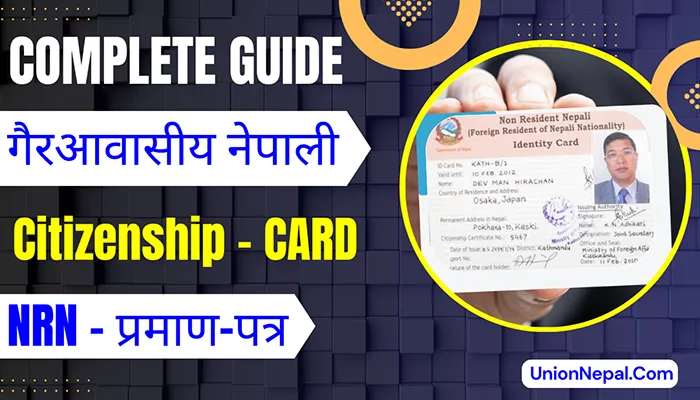
Non-Resident Nepali (NRN) Citizenship Complete 2026 Guide – Eligibility, Process, Documents And Rights
If you are of Nepali origin and hold foreign citizenship outside SAARC countries, Nepal’s Non-Resident Nepali (NRN) Citizenship is a legal pathway that reconnects you with your homeland – granting economic, social and cultural rights without requiring you to surrender your foreign passport.
NRN Citizenship was introduced under Article 14 of the Constitution of Nepal and is governed by Section 7A of the Nepal Citizenship Act, 2006 (amended 2022). Distribution of NRN Citizenship certificates has officially commenced.
Also Helpful : How To Apply E Passport Online In Nepal?
What Is NRN Citizenship?
Non-Resident Nepali (NRN) Citizenship is a special legal status granted by the Government of Nepal to individuals of Nepali origin who have acquired foreign citizenship in a non-SAARC country.
It is not full dual citizenship – Nepal’s Constitution does not recognize dual citizenship – but it is a constitutionally backed status granting meaningful economic, social and cultural rights within Nepal.
In Plain Terms: Even if you carry a foreign passport, your Nepali roots matter. NRN Citizenship allows you to invest, own property, participate in cultural life and access social protections in Nepal.
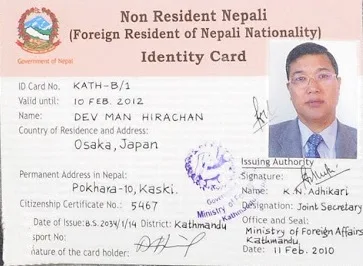
NRN Identity Card Vs. NRN Citizenship Certificate
These are two separate documents issued by different authorities. Both are important.
| Feature | Details |
| NRN Identity Card | • Issued by MoFA or Nepali Embassies/Consulates. • Valid for 10 years (foreign nationals) or 2 years (Nepali nationals abroad). • Applied online nrn.mofa.gov.np • Fee: Approximately USD 520 (foreign nationals) / USD 70 (Nepali nationals abroad). |
| NRN Citizenship Certificate | • Issued by the District Administration Office (DAO/CDO) inside Nepal. • Constitutionally backed under Section 7A. • Grants economic, social & cultural rights. • Valid indefinitely. • Applied in-person at the relevant DAO. |
| Relationship | • To apply for NRN Citizenship, you must hold (or apply simultaneously for) the NRN Identity Card. • The NRN card is the gateway document; citizenship is the higher-status certificate. |
Note: Most Nepali Embassies currently do NOT process NRN Citizenship applications. They advise applicants to appear in person at the relevant DAO inside Nepal.
Eligibility Criteria
You must satisfy all seven criteria below to qualify for NRN Citizenship:
| Criterion | Requirement |
| Nepali Ancestral Origin | You, your parent or grandparent (up to three generations) must have been a Nepali citizen by descent or birth (Wamshaj or Janma). |
| Non-SAARC Foreign Citizenship | You must currently hold citizenship of a country outside SAARC (excludes India, Pakistan, Bangladesh, Sri Lanka, Bhutan, Maldives, Afghanistan). |
| Renunciation of Former Nepali Citizenship | If you previously held Nepali citizenship, you must have renounced it and submit the Renunciation Certificate. If born abroad and never held Nepali citizenship, this does not apply. |
| Minimum Age 16 | No provision exists for applicants under 16. Children under 16 may obtain a Nepali birth registration certificate to support future applications. |
| Physical Presence in Nepal | You must appear in person at the DAO for identity verification (Sanaakhat). Agents cannot represent you at this stage. |
| Commitment to Nepal’s Constitution | You must sign a Commitment Letter (Schedule 8-Gha) pledging to abide by Nepal’s Constitution, laws, and national interests. |
| Clean Legal Record | NRN Citizenship will not be granted or will be revoked if the applicant has been convicted of any criminal offence involving moral turpitude. |
Real-Life Case (2026): A person whose father held Naturalized Nepali Citizenship and whose mother held ancestral Nepali citizenship successfully obtained NRN Citizenship by applying from the mother’s district. Eligibility can flow through any one eligible ancestor.
Rights Granted And Limitations
Rights Granted
- Economic Rights: Invest in Nepal, open and operate foreign-currency bank accounts, repatriate profits.
- Property Rights: Purchase land/property for residential purposes (within area limits) – inherit and receive property through family partition.
- Social Rights: Reside in Nepal, participate in social events and marry under Nepali law, access social services.
- Cultural Rights: Full participation in Nepal’s cultural heritage and traditions.
- Visa-Free Entry: 10-year multi-entry NRN visa for Nepal.
- Business Facilitation: Treated as foreign investors under FITTA 2019; invest in industries, shares, and secondary securities markets.
- Tax Benefit: Remittances to family members up to NPR 15 lakh may be exempt from income tax.
Key Limitations
- No voting rights in national or local elections.
- Cannot contest elections or hold elected/political government positions.
- No right to a Nepali passport.
- Not full dual citizenship – a constitutionally permitted special status only.
- Property purchase is subject to area restrictions (see Section 8).
Two Application Channels
| Channel | Details |
| Path A – Direct at DAO (Recommended) | • Apply in person at the CDO/DAO in the district where your or your ancestor’s Nepali citizenship was originally issued. • Processing: 10–12 working days once documents are complete. • Most reliable and recommended path. |
| Path B – Through Nepali Embassy Abroad | • Submit at the Nepali Embassy/Consulate in your country. • Embassy forwards to MoFA, which transmits to the relevant DAO. • Timeline: significantly longer. • As of 2025, most Embassies redirect applicants to Nepal’s DAO – confirm with your Embassy before attempting. |
Complete Document Checklist
A. For Renunciation Of Nepali Citizenship (If Applicable)
- Original Nepali citizenship certificate.
- Original Nepali passport.
- Copy of foreign passport.
- Parent/sibling’s citizenship as witness proof.
B. For Ward Office Recommendation (Sifaris)
- Personal application letter (in Nepali).
- Proof Of Nepali Origin: own citizenship (1st gen) / parents citizenship (2nd gen) / grandparents citizenship + relationship certificate (3rd gen).
- Three-generation (Teen Pustha) lineage details with citizenship certificate numbers.
- Citizenship Renunciation Certificate (if applicable).
- Proof of residency in a non-SAARC country (embassy-certified letter, utility bill or tenancy contract).
- Copy of foreign passport and foreign citizenship certificate.
- NRN Identity Card copy (if already obtained).
- Birth and marriage certificates.
- Passport-size photos (multiple copies, 4 cm x 3 cm).
C. For DAO – NRN Citizenship Application
- Completed application form – Schedule 8-Ga (original, Nepali paper).
- Commitment Letter – Schedule 8-Gha (signed).
- Oath form – Schedule 8-Cha (to be signed before CDO officer).
- Ward Office Sifaris (recommendation letter).
- Citizenship Renunciation Certificate (original + copies).
- Teen Pustha (three-generation lineage) proof.
- Foreign passport (original + copies).
- Foreign citizenship certificate (original + copies).
- Parents/grandparents Nepali citizenship certificates (original + copies).
- Birth certificates and relationship proof documents (Nata Praman).
- Proof of foreign residence.
- NRN Identity Card (if obtained).
- Passport-size photos (multiple).
- Witness’s original Nepali citizenship certificate and Nata Praman.
Practical Tip: Carry all original documents plus at least 3–4 sets of photocopies. Officers may request originals at any stage. Do not permanently leave originals anywhere – they are returned after verification, except at renunciation where your original Nepali citizenship and passport are surrendered.
Step-By-Step Application Process
Step 1 – Preparation (Before Travelling To Nepal)
- Gather Family Documents: Nepali citizenship certificates and passports of yourself (if any), parents and grandparents. Collect birth certificates, marriage certificates and relationship documents (Nata Praman) for all three generations.
- Obtain Ward Office documents (Nata Praman, birth registration) before renunciation – the renunciation requires surrendering your original Nepali citizenship card.
- Prepare 8–10 passport-size photos (4 cm x 3 cm). Multiple offices will require them.
- Convert Dates: Application forms require both A.D. and B.S. (Bikram Sambat) dates. Use an online converter.
- Identify Your DAO: Apply at the DAO where your or your ancestor’s Nepali citizenship was originally issued.
- Arrange A Witness: At least one Nepali citizen who knows you must appear in person at the DAO to verify your identity (Sanaakhat). Arrange this in advance.
Step 2 – Renunciation Of Nepali Citizenship (If Previously Held)
- Visit the DAO and collect the renunciation form (printed on Nepali paper – originals only, no photocopies).
- Submit the form with your original Nepali citizenship certificate, original Nepali passport, copy of foreign passport and a parent/relative’s citizenship as witness proof.
- Obtain Police Clearance: The DAO issues a Police Clearance Request Letter. Take it to the designated police station for a sealed clearance letter.
- Return to the DAO with the police clearance. Receive the Nagarikta Parityag Patra (Citizenship Renunciation Certificate). Keep multiple certified copies.
Step 3 – Ward Office Recommendation (Sifaris)
- Visit the ward office (Palika) of your or your ancestor’s permanent residential area in Nepal.
- Submit an application for a recommendation letter (Sifaris) with – citizenship certificates, renunciation certificate, three-generation lineage (Teen Pustha), foreign passport, NRN card (if obtained), birth/marriage certificates, and photos.
- Fee: approx. NRs. 10,000/-
- Receive the Sifaris (recommendation letter per Schedule 8-Ga) from the ward office.
Step 4 – Application At The DAO/CDO
- Collect NRN Citizenship application forms from the DAO: Schedule 8-Ga (main form), Schedule 8-Gha (Commitment Letter), and Schedule 8-Cha (Oath form). Forms must be originals printed on Nepali paper.
- Fill out all forms accurately (personal details, three-generation ancestry, foreign residence and declaration of no criminal conviction).
- Submit all forms and documents in person. The DAO will not accept agent-submitted applications for this stage.
- Identity Verification (Sanaakhat): A Nepali citizen witness must appear in person with their original citizenship certificate and relationship proof document.
- Oath of Allegiance (Shapath): Sign Schedule 8-Cha before the CDO or designated officer.
- Verify pre-issuance details, provide biometrics (fingerprints and photo), and receive your NRN Citizenship Certificate (Gairaawasiya Nepali Nagarikta Praman Patra).
Timeline: Applying at a DAO typically takes 10–12 working days when all documents are complete. Some offices process in 2–3 days if documents are perfectly in order. Plan for at least two weeks.
NRN Identity Card – Online Application (Embassy Process)
The NRN Identity Card can be applied online via the MoFA portal. Process for USA (Washington D.C. Embassy).
- Go to nrn.mofa.gov.np and Create An Account and Log In.
- Select Your Category: ‘Foreign National Of Nepali Origin’ (Foreign Passport) OR ‘Nepali Nationals Residing Abroad’ (Still Holding Nepali Passport).
- Select Agency: ‘Embassy of Nepal, Washington DC, USA – 326003528’.
- Upload Documents: PDFs max 500 KB; photos/signatures in JPEG/PNG max 150 KB. Follow generation-specific proof requirements.
- Pay Fee: USD 520 by cashier’s check/money order payable to ‘Embassy of Nepal, Washington D.C.’
- Processing Time: 10–15 business days.
- Mail/Drop-Off To: Embassy of Nepal, 2730 34th Place NW, Washington DC 20007 or collect in person.
Common NRN Card Portal Issues
| Issue | Solution |
| Login shows ‘Incorrect Password’ even when correct | Sign up again with a different email address |
| Cannot save application information | Leave as-is – it will be addressed during Embassy review |
| Date changes unexpectedly during application | Leave as-is – Embassy will correct during review |
| Photo upload fails | Ensure JPEG/PNG file is under 150 KB |
| PDF upload fails | Ensure PDF file is under 500 KB |
Property Rights Under NRN Citizenship
One of the most valued NRN Citizenship benefits is the right to purchase and hold property in Nepal, governed by NRN Rules 2009 (Rule 11) and the Muluki Civil Code 2017 (Sections 432–433).
Land Purchase Limits For NRN Citizens
| Location | Maximum Permitted Area |
| Kathmandu Valley (urban areas) | Up to 2 Ropani |
| Terai District – Municipalities | Up to 8 Kattha |
| Other Municipalities (outside Kathmandu & Terai) | Up to 8 Ropani |
| Terai District – Village Municipalities (Rural) | Up to 1 Bigha |
| Hill/Mountain Village Municipalities | Up to 4 Ropani |
Property Acquisition Procedure
- Mandatory: Hold the NRN Identity Card before purchasing property.
- Submit application to MoFA (Ministry of Foreign Affairs) with property location, area and agreed price.
- MoFA Secretary Reviews and grants approval if within permitted limits.
- Register at the Land Revenue Office – NRN-owned land receives a blue-print certificate.
Other Modes Of Property Acquisition
- By Partition (Amsha Banda): Under Section 433 of the Muluki Civil Code, NRN citizens can receive and register property through family partition.
- By Inheritance: NRN citizen’s property in Nepal can be inherited by legal heirs who hold an NRN ID card.
- By Investment: NRN citizens can invest in Nepal under FITTA 2019 – in industries, shares, secondary securities markets and other approved modes.
Governing Legal Framework
NRN Citizenship is governed by the following laws.
- Constitution of Nepal, 2015 – Article 14
- Nepal Citizenship Act, 2006 – Section 7A (added by First Amendment Act, 2079/2022)
- Nepal Citizenship Rules, 2006 – Rule 8A and Schedules 8-Ga, 8-Gha, 8-Cha (amended 2080 B.S./2023)
- Non-Resident Nepali Act, 2008 and NRN Rules, 2009 – Rule 11 (property acquisition)
Key Policy Updates (2026)
| Aspect | Current Position (2025) |
| Legal Basis | Section 7A inserted into Nepal Citizenship Act 2006 by First Amendment Act 2079 (2022). Rule 8A and Schedules 8-Ga, 8-Gha, 8-Cha added in 2080 B.S. (2023). |
| Certificate Distribution | Officially commenced. Government has issued NRN Citizenship certificates to initial applicants. |
| Embassy Applications | Technically allowed but practically not being processed. Almost all Embassies redirect to DAO in Nepal. |
| Three-Generation Rule | CDO offices require Teen Pustha (three-generation) proof of Nepali lineage at multiple stages. |
| NRN Card Prerequisite | NRN Citizenship application is linked to NRN ID card – needed for property rights. |
| Replacement Certificates | No formal replacement process as of August 2024 for lost/damaged certificates. Verify with your DAO. |
| DAO Fees | Approx. NPR 10,000 at ward office. Additional miscellaneous fees at DAO and police station. |
| NRN Card Fees (US Embassy) | USD 520 for foreign nationals of Nepali origin – USD 70 for Nepali nationals residing abroad. |
Practical Tips From Real Applicants
- Plan For Multiple Trips: Budget at least 10–12 working days in Nepal for Ward Office, Police Station and DAO visits.
- Use Original Forms Only: CDO offices require original printed forms on Nepali documents – photocopied forms may be rejected.
- Prepare 8–10 passport photos minimum across all stages.
- Get Ward Office documents before renunciation: Complete all birth registrations and relationship proofs before surrendering your original Nepali citizenship card.
- Cite The Law If Needed: Some DAO officers may be unfamiliar with the process. Politely reference Article 14 (Constitution), Section 7A (Citizenship Act) and Rule 8A (Citizenship Rules).
- Apply From The Right District: Eligibility can flow from either parent or grandparent. If one path is blocked, explore applying from another eligible ancestor’s district.
- Keep Multiple Certified Copies: There is currently no easy replacement process if your NRN Citizenship Certificate is lost or damaged.
- Check For Updates: NRN regulations continue to evolve. Verify current requirements with the DAO or a legal practitioner before applying.
Disclaimer: This article is for general informational and educational purposes only. It does not constitute legal advice. NRN citizenship laws and procedures are subject to change. Always verify current requirements with the relevant District Administration Office or a qualified Nepali legal practitioner before applying.