
Nepal Driving License Exam Preparation – Likhit Practice, Vision Test, Traffic Signs, Model Question & Complete Guide
Passing Nepal’s Driving License Likhit Exam (लिखित परीक्षा) comes down to 3 things – studying the right topics, practicing in the real exam style and reviewing your mistakes instead of just memorizing answers.
This page helps you to practice traffic rules, traffic signs and vision test questions for Category A/K (motorcycle, scooter) and Category B (car, jeep, van etc.) – application steps and fees are included for your convenience.
Category B Practice Questions
Category A Practice Questions
Practice Questions
Driving Knowledge Questions
Vehicle Act Questions
Mechanical Questions
Environment Questions
Accident Awareness Questions
Quick Exam Preparation Reference
| Preparation Point | What To Remember |
| Commonly used written-test format | 25 multiple-choice questions, 30 minutes |
| Commonly cited pass requirement | 60 marks out of 100 (15 correct answers, 4 marks each) |
| Core study areas | Driving knowledge, vehicle law, technical knowledge, environment, accident awareness, traffic signals |
| Best preparation method | Section-wise study, repeated exam practice, visual traffic-sign revision, timed mock tests |
| Important caution | Official DoTM publications and local office notices don’t always match – see the format comparison below and confirm before your exam |
Official Question Bank & PDF Downloads
All questions are sourced directly from the official DoTM (Department of Transport Management).
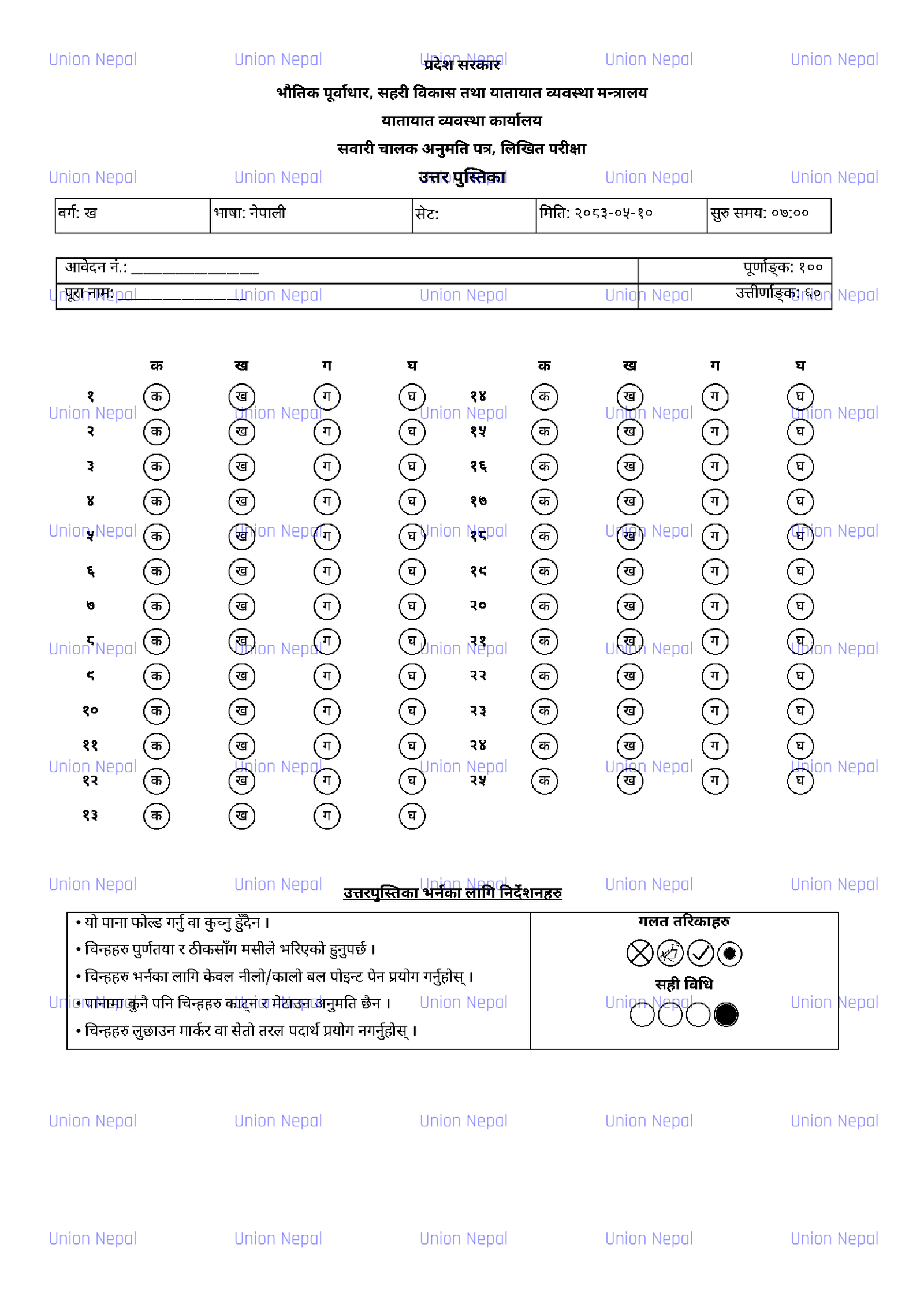
Sample Question Paper For Driving License Exam Preparation
See an actual likhit exam question paper sample before test day.

What Is the Nepal Driving License Likhit Exam?
The Likhit Exam is the written, computer-based knowledge test taken during Nepal’s driving license process, before the practical trial.
It checks whether an applicant understands the rules needed to drive responsibly – road behavior, traffic signs, right-of-way, safe driving decisions, basic vehicle operation, vehicle law, environmental responsibility and accident awareness.
Exam Format
Preparation platforms and official publications don’t always agree on the exact numbers. Rather than pick one silently, here’s a transparent comparison so you can plan around the version that matches your local DoTM notice.
| Source | Questions | Marks Each | Pass Mark |
| Most preparation platforms & practice | 25 | 4 | 60 / 100 (15 Correct) |
| Official DoTM 2078 Category A/K question-bank booklet | 20 | 5 | 80 / 100 |
| Some official-style answer sheets in circulation | 25 | 4 | 60 / 100 |
The 6 Core Subject Areas Of The Likhit Exam
Whichever exact format applies at your office, the same 6 subject areas repeat across every version of the Nepal driving license written test.
| Subject Area | What It Covers |
| Driving Knowledge | Lane use, overtaking, following distance, right-of-way, indicators, speed, and general road behavior |
| Vehicular Act & Regulation | License categories, minimum ages, required documents, validity periods, and legal duties |
| Technical / Mechanical Knowledge | Tyres, brakes, warning lights, engine condition and routine vehicle checks |
| Environmental Pollution | Vehicle emissions, pollution control, fuel-saving habits and eco-driving |
| Accident Awareness | Accident prevention, safe first response and reporting serious incidents |
| Traffic Signals & Road Signs | Mandatory, prohibitory, warning and informatory signs used to guide drivers |
Driving Knowledge
Nepal follows left-hand traffic – vehicles drive on the left and overtake from the right. At an unmarked intersection, the vehicle arriving from the right generally has priority and on hill roads the downhill vehicle gives way to the vehicle coming uphill.
Following distance, when headlights are required and how to react to an approaching emergency vehicle also fall under this section.
Vehicular Act & Regulation
Minimum age requirements sit at the centre of this section – 16 years for a motorcycle or scooter license (Category A/K), 18 years for a car or jeep (Category B) and 21 years for heavier commercial categories.
License validity is commonly cited as 10 years for drivers under 60 and 5 years for drivers aged 60 and above. A lost or stolen license should be reported to the nearest transport office promptly and a failed written exam typically means a waiting period before reapplying.
Technical / Mechanical Knowledge
Expect practical questions rather than deep mechanics. A red temperature warning light means the engine is overheating, so you stop immediately. If brakes fail, downshift progressively, then apply the handbrake gradually. On a steep uphill, use a low gear.
There are also basic electric-vehicle facts, like EVs having no exhaust silencer, since they produce no combustion emissions.
Environmental Pollution
Typically the smallest section, but straightforward – diesel engines generally pollute more than petrol, horns contribute to noise pollution, black smoke signals incomplete combustion and needs engine repair and electric vehicles produce zero tailpipe emissions.
Accident Awareness
This section covers what to do before, during and after a road accident – prioritizing safety, calling emergency services (Nepal Police 100, Ambulance 102), not moving an injured person unless there is immediate danger and understanding common accident causes in Nepal such as over-speeding, drunk driving, reckless overtaking and poor visibility.
Traffic Signals & Road Signs
The most visual section, testing recognition of Nepal’s sign categories both by name and by image, including common signs like STOP, No Entry, No Overtaking, Give Way and speed-limit signs.
Choose The Correct License Category Before You Practice
Driving license questions are not identical for every vehicle type. Motorcycle and scooter applicants need two-wheeler knowledge, while car and jeep applicants need light four-wheeler knowledge. Select the same category in any practice tool that you selected in your license application.
| Category | Vehicle Type | Preparation Focus |
| A / K | Motorcycle and scooter | Balance-related safety, helmet and pillion rules, braking technique, motorcycle controls, signs and general traffic rules |
| B | Car, jeep, van, light four-wheeler | Right-of-way, lane discipline, parking knowledge, vehicle controls, technical checks, signs and general traffic rules |
Category A / K – Motorcycle & Scooter Specifics
- Minimum age – 16 years.
- Must hold Category A for a minimum period (commonly cited as 2 years) before applying for Category B.
- Helmet mandatory for both rider and pillion – fines apply for non-compliance.
- Maximum two persons allowed on a motorcycle (rider plus one pillion).
- The front brake provides roughly 70% of a motorcycle’s stopping power – both brakes should be applied together, not the rear brake alone.
- Drive chain should be lubricated roughly every 500-1,000 km.
Category B – Car / Jeep / Van Specifics
- Minimum age – 18 years.
- Covers right-of-way rules, overtaking, license validity, fines and EV knowledge alongside the shared all – section syllabus.
- Trial exam includes a figure-of-eight track and a hill-start exercise.
Nepal Driving License Categories
| Category | Vehicle Type | Typical Min. Age |
| A / K | Motorcycle, scooter, moped | 16 years |
| B | Car, jeep, light van (up to 8 passengers) | 18 years |
| C | Light truck / mini truck | 21 years |
| D | Bus / heavy passenger vehicle | 21 years |
| E | Heavy truck / tipper | 21 years |
| F | Tractor | 18 years |
| G | Road roller | 18 years |
A separate bill under parliamentary review proposes raising these minimums (For example – two-wheelers from 16 to 18 and light four-wheelers from 18 to 21). Until such a change is formally in effect, apply using the current age requirements confirmed at your DoTM office.
How To Apply For A Driving License In Nepal
1. Online Registration
Register on the DoTM’s/Provisional Transportation online application portal with your mobile number, fill in personal details exactly as they appear on your citizenship certificate, upload a passport photo and signature and pick an appointment slot.
2. Biometrics & Medical Check
At the DoTM/Provisional Transportation office – fingerprint scan, digital photo and signature, a vision test at 20 metres (each eye covered separately) and a colour-blindness check. Bring your original citizenship certificate.
3. Likhit (Written) Exam
Sit the computer-based test in Nepali or English. Results are known immediately. A pass moves you to trial booking – a fail generally means a waiting period before reapplying.
4. Trial (Practical) Exam
Category A/K candidates complete a narrow-track balance exercise – Category B candidates complete a figure-of-eight course plus a hill start. A minimum practical score is required to pass.
5. License Issuance & Smart Card
Pay the issuance fee, receive a temporary driving slip valid immediately and wait for the smart card to be printed and collected from the same DoTM/Provisional Transportation office.
Documents You Need For Driving License
- Original Nepali citizenship certificate (plus photocopy).
- Application printout with passport-size photo attached.
- Blood group certificate from a recognized medical centre.
- Eye test / vision certificate from a registered eye specialist (for Category B and above).
- Two recent passport-size photographs with a white background.
- Payment receipts for the applicable exam and license fees.
Double-check that every field on your online application matches your citizenship certificate exactly – spelling differences and date-format mismatches are a common cause of rejected appointments.
Traffic Signs – A High-Priority Study Area
Traffic signs matter in both the written exam and everyday driving. Study them visually rather than learning only their names – pay attention to shape, colour, symbol and purpose so you can recognize them quickly, including in image-based exam questions.
| Sign Category | Shape / Colour | Meaning |
| Mandatory | Blue circle | An action road users must follow |
| Prohibitory | Red circle / octagon | Actions, vehicles or movements that are not allowed |
| Warning | Red-bordered triangle | Upcoming hazard or changing road conditions |
| Informatory | Blue rectangle | Guidance about routes, facilities or services |
Key signs worth memorizing include the octagonal red STOP sign, No Entry (red circle with a white horizontal bar), No Overtaking (red circle with two vehicle silhouettes), the inverted-triangle Give Way sign and speed-limit signs shown as a red-bordered circle with a number.
On hill roads, also expect warning signs for falling rocks, steep descents, hairpin bends, and narrow bridges.
Vision And Colour-Recognition Preparation
Vision screening is part of the broader license process, since drivers must be able to see road conditions and recognize signals correctly.
Online colour-vision activities can help you become familiar with the type of visual task involved, but they are practice tools rather than a medical diagnosis. Practice using a clear screen, normal brightness, and your usual corrective glasses.
Anyone concerned about their eyesight or colour recognition should seek a proper professional assessment and follow the instructions given at the transport office – an online test never replaces the official screening.
A Simple 7-Day Study Plan
| Day | Study Task |
| Day 1 | Learn the exam structure and complete a short baseline test |
| Day 2 | Study driving knowledge, road behavior, lane use and right-of-way |
| Day 3 | Study traffic signs and practice image-based questions |
| Day 4 | Review vehicle laws, license rules and category-specific questions |
| Day 5 | Study technical knowledge, pollution and accident awareness |
| Day 6 | Take two timed mock tests and review every wrong answer |
| Day 7 | Revise weak topics, take one final mock and prepare exam-day documents |
How To Use Online Practice Tests Effectively
1. Start With Section-Wise Practice
Study one topic at a time instead of jumping straight into a full mock exam, so you can identify which rules or signs you don’t understand.
2. Read Every Explanation
A correct answer is useful, but understanding why it’s correct helps you answer differently worded questions.
3. Review Wrong Answers Immediately
Keep a short list of repeated mistakes, especially traffic signs, right-of-way and category-specific rules.
4. Move To Mixed-Question Practice
Once your topic scores improve, practice questions from all sections together.
5. Finish With Timed Mock Tests
Use a 30-minute timer and complete the full question set without interruption to build speed and reduce exam-day pressure.
6. Repeat Weak Sections
Don’t only repeat tests you already pass – spend more time on the subjects where your score stays low.
Common Preparation Mistakes To Avoid
- Using only one small test set that doesn’t cover all subject areas.
- Ignoring traffic-sign images – visual questions require recognition, not just text memorization.
- Practicing the wrong vehicle category, since knowledge differs between motorcycles and light four-wheelers.
- Repeating tests without reviewing mistakes – practice only helps once wrong answers are understood.
- Relying on a single unofficial source for exam-format details instead of confirming with your transport office.
- Underestimating the technical/mechanical section, which offers easy marks many candidates skip.
License Fees And Common Fines (Quick Reference)
Driving license Fee Schedule For Fiscal Year: 2083/2084
| SN | Category | New License Fee (NRs.) | Renewal Fee (NRs.) |
| 1 | A-Motorcycle, Scooter, Moped | 3000.00 | 3000.00 |
| 2 | B-Car, Jeep, Delivery Van | 4000.00 | 4000.00 |
| 3 | C-Tempo, Autorickshaw | 4000.00 | 4000.00 |
| 4 | C1-ERickshaw | 4000.00 | 4000.00 |
| 5 | D-Powertiller | 4000.00 | 4000.00 |
| 6 | E-Tractor, Trailer Tractor (Low Bed) | 5000.00 | 5000.00 |
| 7 | F-Minibus, Minitruck | 5000.00 | 5000.00 |
| 8 | G-Truck, Bus, Lorry | 6000.00 | 6000.00 |
| 9 | H-Road Toller, Dozer | 6000.00 | 6000.00 |
| 10 | H1-DOZER | 6000.00 | 6000.00 |
| 11 | H2-ROAD ROLLER | 6000.00 | 6000.00 |
| 12 | I-Crane, Fire brigade, Loader | 6000.00 | 6000.00 |
| 13 | I1-CRANE, MOBILE CRANE, CRANE MOUNTED TRUCK | 6000.00 | 6000.00 |
| 14 | I2-FIRE BRIGADE | 6000.00 | 6000.00 |
| 15 | I3-LOADER | 6000.00 | 6000.00 |
| 16 | J1-EXCAVATOR | 6000.00 | 6000.00 |
| 17 | J2-BACKHOE LOADER | 6000.00 | 6000.00 |
| 18 | J3-GRADER | 6000.00 | 6000.00 |
| 19 | J4-FORKLIFT | 6000.00 | 6000.00 |
| 20 | J5-Other | 6000.00 | 6000.00 |
| 21 | K-Scooter, Moped | 3000.00 | 3000.00 |
| 22 | L-Scooter | 0.00 | 0.00 |
| 23 | M-Moped | 0.00 | 0.00 |
| 24 | N-Motorcycle | 0.00 | 0.00 |
| 25 | PAPERCARD ENTRY | 0.00 | 0.00 |
Fees and fines are periodically revised by DoTM notice, so treat the figures above as a general guide and confirm the current amount at your local office or the official portal before paying.
Why The Written Test Matters – Nepal’s Road Safety Context
Road traffic accidents are a serious public safety issue in Nepal. Motorcycles are involved in most reported crashes, and over-speeding is the leading cause, followed by drunk driving and reckless overtaking.
Nepal’s road fatality rate is also notably higher than the regional average.
This isn’t meant to discourage driving. It explains why the written test exists: a driver who understands right-of-way, following distance, signs and emergency procedures is safer than one who just memorized answers.
How To Check Your Likhit Exam Result
Result publication methods can differ by office. Use the exact method announced by the office where you completed the exam, and avoid entering personal details on unrelated websites.
- DoTM office notice board – useful if you live nearby.
- Official DoTM website – look for the Written Test or Written Exam Result section.
- SMS service – message your applicant ID in the format specified by DoTM to the official short code.
- Official DoTM office Facebook pages – many offices post results as image or PDF announcements.
Final Preparation Checklist
- The right license category, practiced specifically.
- All six major written-exam subject areas covered.
- Traffic signs recognized on sight, not just by name.
- A few timed mock tests done, so exam pressure isn’t a surprise.
- Repeated mistakes reviewed – that’s usually where real gaps hide.
- Current exam-format instructions confirmed with your selected DoTM office.
- Documents and details ready for exam day.
Final Tips Before Exam Day
- Arrive at least 30 minutes early with your original citizenship certificate, admit card and payment receipt.
- Read the complete question and every option before choosing an answer – don’t rely on option position, since ordering can change.
- Give extra attention to traffic signs and rules you repeatedly answer incorrectly.
- Take timed mock tests in a quiet place without checking notes.
- Sleep properly before the exam and avoid last-minute cramming.
Passing the Likhit exam is a threshold, not the destination – what matters on Nepal’s roads is whether you apply the rules consistently. Start with section-wise learning, review every mistake and use timed mock tests to measure real readiness before your exam day.