
Korea Visa From Nepal – Complete Guide For Work, Study And Travel
South Korea (Republic of Korea) is one of the most popular destinations for Nepali citizens seeking work, higher education and a better future. With a monthly minimum wage of around NRs. 1.7-1.9 lakh (Approximately KRW 2,060,000).
Korea offers genuine opportunities that few other countries match. Every year, thousands of Nepali workers and students travel to Korea through government-approved channels.
This guide covers every visa type available for Nepalese citizens when going or traveling to South Korea. It includes like.
- Korea Visa – Types available in Nepal.
- EPS (E-9)/TOPIK – Employment Permit System visa for workers.
- Student Visas – D-4 and D-2 visas for studying in South Korea.
- Caregiver Visa – E-7-2 visa.
- Worker Visa – E-7 visa.
- Tourist Visas – C-3 visa.
- Document Required for Korea visa Application.
- How to check your Korea Visa status online.
- Total Cost – During Korea Visa from Nepal.
- Success rate of Korea Visa from Nepal.
1. Types Of Korea Visa Available From Nepal
Nepali citizens can apply for several categories of South Korean visa depending on their purpose of travel. Below is a complete overview table based on 2025/2026 official requirements.
| Visa Type | Purpose | Age | Max Stay | Key Details |
| E-9 (EPS) | Work | 18-39 Years | 4 Years 10 Months | Manufacturing, Agriculture, Construction, Fishery – EPS-TOPIK required |
| E-7 (Skilled) | Work | No fixed limit | 1-3 Years (renewable) | Chef/Cook, IT, Engineering, Caregiver – employer sponsorship + skill test |
| E-7-4 (Upgrade) | Work | E-9 holders | Renewable | 4+ Years on E-9 , K-Point 200+, KRW 26M/Years min salary – leads to F-5 PR |
| D-4 (Language) | Study | 18+ Years | Up to 2 Years | Korean language course at approved university – TOPIK Level 3-4 for D-2 transition |
| D-2 (Degree) | Study | 18+ Years | Duration of study | Bachelor/Master/PhD – IELTS 5.5+ or TOPIK – GPA 2.4+ typically required |
| C-3/B-2 (Tourist) | Visit | Any | Up to 90 days | Bank statement, hotel booking, TB test – NRs. 5,400 fee – no work allowed |
Important: There is no single Korea visa from Nepal. Your visa category depends entirely on your purpose – work, study or tourism. Each has different documents, fees, age limits and processing channels. Choosing the wrong category is one of the most common and costly mistakes.
2. EPS TOPIK Exam Nepal – Apply, Prepare And Pass
The Employment Permit System (EPS) is the government-to-government (G2G) programme that allows Nepali workers to go to South Korea for unskilled and semi-skilled work under the E-9 Non-Professional Employment Visa. Nepal has maintained a formal EPS MOU with South Korea since 2007.
Who Can Apply For EPS In Nepal?
- Age: 18 to 39 years at the time of application.
- Education: At least SEE/SLC pass (no specific percentage required).
- Health: Medically fit – TB clearance mandatory.
- Character: Clean police report (no criminal record).
- Passport: Valid Machine Readable Passport (MRP).
- Language: Must pass EPS-TOPIK exam (Korean proficiency test).
- Gap: No restriction on study or work gap years for E-9.
EPS-TOPIK Exam – What You Need To Know
The EPS-TOPIK (Employment Permit System – Test of Proficiency in Korean) is administered by HRD Korea (Human Resources Development Service of Korea) in coordination with DoFE Nepal (Department of Foreign Employment).
The test has 2 sections – Listening (25 questions) and Reading (25 questions), totaling 200 marks. Minimum passing marks vary by year and quota.
EPS form registration for the current cycle opened Shrawan 20 (approximately late July/early August). Manufacturing and Agriculture sectors are open.
After form submission, the exam schedule is published and a roll number slip is issued online. After passing, the medical test, job application and visa process begin in sequence. See the step-by-step EPS process table below.
EPS Process For Nepali Workers
| S.N. | Steps | What Happens |
| 1 | Register For EPS-TOPIK | • Apply at DoFE-EPS Korea Branch, Gwarko, Lalitpur. • Form opens Shrawan 20 (July/Aug). • Age 18-39. • Manufacturing and Agriculture sectors open. • Documents – passport, citizenship, SEE/SLC certificate. |
| 2 | Pass EPS-TOPIK Exam | • Listening (25 questions) and Reading (25 questions). • Total 200 marks – minimum passing varies by quota year. • Scoring higher improves employer selection priority. |
| 3 | Skill / Health Assessment | • Medical fitness test at designated hospitals (Patan Hospital, Civil Service Hospital, Korea-Nepal Friendship Hospital, Sukraraj Tropical and Infectious Disease Hospital). • TB clearance mandatory for all long-stay visas. |
| 4 | Enter HRD Korea Job Roster | • Passed candidates are listed on HRD Korea portal. • Korean employers browse the roster and send job offers. • Wait time varies – 2 weeks to 6+ months depending on quota and sector. |
| 5 | Sign Labour Contract And Pre-Departure Training | • Employment contract signed through DoFE. • Mandatory pre-departure training at CTEVT or DoFE-designated centre. • Insurance and welfare fund deposit required (Foreign Employment Act, 2008). |
| 6 | Receive E-9 Visa And Depart | • Korean Embassy Kathmandu issues E-9 visa on recommendation of HRD Korea. • Monthly salary: NRs. 1.7-1.9 lakh (Approximately KRW 2,060,000). • Accommodation usually provided by employer. |
Note For EPS Exam Repeaters: If you have already taken the EPS-TOPIK and passed but were not selected or if you failed and want to try the D-4 student visa route instead, See Section 3 Below. Your Korean language preparation is still valuable.
3. Korea Student Visa From Nepal – D-2 And D-4 Visa Explained
South Korea offers two primary student visa categories for Nepali applicants. The D-4 visa is for language study (Korean or English medium courses) and the D-2 visa is for full degree programmes – Bachelor’s, Master’s or PhD. Both visas allow part-time work in Korea after the first semester or 6 months.
D-4 Visa – Korean Language Study Route
The D-4 visa (also called Language Training Visa) allows Nepali students to study Korean or other languages at an approved Korean University Language Centre.
This is typically the first step for students who want to eventually pursue a D-2 degree but do not yet have sufficient language skills. Duration – up to 2 years.
- Minimum Requirement: 12 years of schooling completed (SLC/SEE + Plus 2).
- Language: Basic Korean (TOPIK Level 2 recommended; some universities accept lower).
- GPA: Most universities accept 2.4 GPA and above – some accept lower.
- Gap: Universities assess individually – gaps of 4-6 years have been accepted.
- Bank Balance: Proof of funds required – approximately USD 10,000 in fixed deposit.
- After 6 Months: Part-time work permitted (up to 20 hours/week during term).
- Cost: Approximately NPR 7-9 lakh total (tuition + ticket + insurance + living).
D-4-1 Vs D-4-7 Visa – What Is the Difference?
D-4-1 is for Korean language study – D-4-7 is for study of other languages (English, Japanese, Chinese, German, French) at Korean universities.
Both fall under the same D-4 visa category and have similar rules, but differ in which universities can issue them.
Top-ranked universities issue D-4-1 (higher visa approval rate). D-4-7 is issued by a wider range of universities. If you already have Korean language skills (TOPIK Level 3+), D-4-7 in English medium may be a faster path.
After arrival in Korea on D-4, students can convert to D-2 degree status after completing language training – usually within 6 months to 1 year.
This conversion requires – enrollment confirmation from the new university, attendance records, mark sheet and relationship certificate (citizenship) from Nepal.
D-2 Visa – Degree Programme (Bachelor’s, Master’s, PhD)
The D-2 visa is for Nepali students enrolled in a formal degree programme at a Korean university. It is the most common long-term student visa for those wishing to study in South Korea from Nepal.
- Minimum Requirement: Plus 2 / A-Levels completed for Bachelor’s – Bachelor’s for Master’s.
- Language: TOPIK Level 3-4 (Korean medium) or IELTS 5.5-6.5 (English medium).
- GPA: Typically 2.4-2.8 minimum; varies by university.
- Bank Balance: Approximately USD 20,000 fixed deposit for D-2 visa.
- Tuition Fees: Approx. NRs. 4-12 lakh per year (KRW 4,000,000-12,000,000).
- Living Costs: Approx. NRs. 10-15 lakh per year (KRW 9,000,000-18,000,000).
- Work Rights: Up to 35 hours/week during term – full-time during vacation.
- Intakes: Spring (March) – apply Sept-Nov – Fall (September) – apply March-May.
4. Korea Caregiver Visa (E7-2) – Real Process From Nepal
In recent years, Korea Caregiver Visa from Nepal has become a widely discussed topic – and also one of the most misunderstood.
Many consultancies in Nepal have been collecting documents and fees claiming to process a direct caregiver visa. This section explains the truth, backed by official Korean and Nepal government sources.
The Truth: There is no direct Caregiver Visa issued from Nepal to Korea. There is no separate bilateral agreement between Nepal and Korea that allows caregiver workers to travel directly. Any consultancy claiming to process a direct Care Giver Visa from Nepal is misleading you.
Why Is There Such High Demand For Caregivers In Korea?
South Korea is aging faster than almost any other nation. As of 2025, approximately 29% of Korea’s population is aged 65 or above. This has created an enormous demand for trained caregivers.
The Korean government projects a need for hundreds of thousands of new caregivers by 2050. This is a real and growing opportunity – but the path is structured and takes time.
The Legal And Official Caregiver Pathway From Nepal
The Korean government has approved 3 pathways to work as a caregiver in Korea. For Nepali citizens starting from Nepal, the most relevant pathway is the T4 University Caregiver Programme.
This programme began enrolling in 2026 through 24 government-approved universities. The complete roadmap is below.
| Stage | Action | Details |
| Stage 1 (Nepal) | Start Korean Language | Learn Korean to TOPIK Level 3 minimum. Takes 6-12 months of dedicated study. No shortcut exists. |
| Stage 2 (Nepal) | Apply To T4 University Program | 24 government-approved universities run caregiver-track associate degree programs. Bank balance rules are relaxed for these 24 institutions. |
| Stage 3 | Get D-2 Student Visa | Apply for D-2 visa through Korean Embassy Kathmandu. Documents – TOPIK certificate, admission letter, financial proof, TB clearance. |
| Stage 4 (Korea) | Complete Associate Degree and National Certification | Study 2 years. Pass the National Care Worker Certification. This certificate is mandatory for E7-2 visa eligibility. |
| Stage 5 (Korea) | Find Employer and Get E7-2 Visa | Apply for caregiver jobs in regional areas. Korean government gives priority to rural/regional areas. Change visa from D-2 to E7-2. |
| Stage 6 (Long-term) | Work 2-3 Years Toward F-5 PR | After E7-2 employment for 2-3 years in a qualifying area, apply for F-5 Permanent Residency. Monthly earnings – approximately NRs. 1.9 lakh (KRW 2,200,000). |
Key Point For You: If anyone charges you for a Direct Caregiver Visa From Nepal or offers a shortcut without the D-2 study process – do not pay. The official, legal route requires study in Korea first. Monthly caregiver salary after completing training – approximately NRs. 1.9 lakh (KRW 2,200,000). After 2-3 years of E7-2 work, you become eligible to apply for F-5 Permanent Residency.
5. Working Visa For Korea From Nepal – E-7 Visa Guide
The E-7 Specific Activities Visa is South Korea’s professional and skilled worker visa. Unlike the EPS/E-9 route which is managed government-to-government, the E-7 visa requires a direct employment offer from a registered Korean company.
Nepal formalized the E-7 skilled worker pathway in November 2024 through new procedures approved by the Ministry of Labour, Employment and Social Security.
E-7 Visa Sub-Categories For Nepali Workers
- E-7-1 (Professional): IT engineers, software developers, mechanical engineers, chefs/cooks, marketers, HR managers – 67 occupations listed. Requires Bachelor’s degree + 1 year experience, or Master’s degree, or 5 years of experience.
- E-7-2 (Semi-Professional): Caregivers, hotel receptionists, medical coordinators. Lower salary threshold. Often accessible to trade-qualified workers.
- E-7-3 (General Skilled): Ship welders, auto body workers, halal slaughterhouse workers (added Jan 2026). Specific trade qualifications required.
- E-7-4 (Points-Based Upgrade): For Nepali workers already in Korea on E-9 for 4+ years. Requires KRW 26,000,000/year minimum salary, employer recommendation and K-Point score of 200+.
E-7 Salary Requirements (2026)
- E-7-1: Minimum approximately KRW 3,250,000/month (80% of Korea’s GNI per capita). Small/medium certified businesses: 70% threshold.
- E-7-2 And E-7-3: Korean minimum wage or above – KRW 2,060,000/month in 2025.
- E-7-4: Annual salary of at least KRW 26,000,000 (approximately KRW 2,167,000/month).
- Only base salary and fixed allowances count. Meal and transport reimbursements do not count toward the threshold.
Nepal Government Official E-7 Procedure (2026)
The Nepal Ministry of Labour published the Procedure for Sending Skilled Workers to the Republic of Korea, 2024 (approved February 29, 2024 – amended three times, most recently June 27, 2025).
Under this procedure, licensed Nepali manpower companies can send skilled workers to Korea under E-7-1, E-7-2, E-7-3 and E-7-4 categories through private business-to-business (B2B) arrangements, separate from the EPS system.
Key Requirements Of The Official Procedure
A. Requirements For The Manpower Company
- Must have its own training centre or a leased training centre.
- The training centre prepares workers for language and skill assessments.
B. Language & Skill Testing
- The Korean employer visits Nepal to conduct.
- Korean language tests.
- Skill tests.
- No testing fee is charged to workers.
- Workers who pass receive a Certificate of Eligibility from the training centre.
C. Employment Agreement
After passing the tests, the worker and employer sign an employment agreement (4 copies), which must include.
- Salary at or above the applicable minimum wage.
- 8-hour workday.
- 40-hour workweek.
- 2 days of leave per month.
- Employer-provided accommodation.
- Full insurance coverage.
- Annual bonus.
D. Verification By The Nepal Embassy In Seoul
The Nepal Embassy in Seoul verifies the employer’s documents within 15 days, including.
- Employer demand letter.
- Salary and wage details.
- Working conditions.
- Authenticity of the employer.
The Embassy then attests the labour agreement.
E. Pre-Departure Requirements For Workers
Before departure, workers must.
- Complete mandatory orientation training at an institution approved by the Department of Foreign Employment (DoFE).
- Obtain required insurance from a DoFE-listed insurance company.
6. Nepal (C-3 Tourist Visa)
Nepali citizens must obtain a visa before traveling to South Korea. There is no visa-on-arrival facility for ordinary Nepali passport holders.
South Korea Tourist Visa (C-3) – Key Information
- Application Submission: Visa applications must be submitted through the Korea Visa Application Center (KVAC) in Kathmandu, not directly at the Embassy (except for specific exempt categories).
- KVAC Location: First Floor, Onesky Building, 2935 Yela Sadak, Harihar Bhawan, Pulchowk, Lalitpur, Nepal.
- Application Hours: Monday to Friday, 09:00 AM – 04:00 PM.
- Passport Collection Hours: Monday to Friday, 09:00 AM – 05:00 PM.
- Appointment System: Appointment booking remains available through the KVAC website – however, walk-in applications are also accepted according to the current KVAC procedures.
- Passport Validity: Applicants should hold a passport valid for at least six months beyond the intended stay.
- Supporting Documents: Requirements vary depending on the applicant’s profile and visa category. Financial documents, employment/business documents, travel itinerary and other supporting evidence may be requested.
- TB Test Certificate: Required only for visa categories and applicants specified by the Embassy’s health screening requirements. Applicants should verify the latest requirements before applying.
- Processing Time: Approximately 3 weeks (15-21 working days) or longer depending on individual circumstances and Embassy review.
- Document Requirements: Documents not in English or Korean may require certified translation. Additional notarization or consular authentication may be requested depending on the document type.
- Important Notice: Submission of false, forged or misleading documents may result in visa refusal and could affect future visa eligibility.
Korea Tourist Visa Fees (Effective 1 January 2026)
| Visa Type | Fee (Effective 1 Jan 2026) | Notes |
| Single Entry (up to 90 days) | NRs. 5,800 | Standard C-3 tourist visa – Most common for tourism |
| Single Entry (over 90 days) | NRs. 8,700 | Long-term stay categories requiring over 90 days – Medical/business stays |
| Double Entry (up to 30 days) | NRs. 10,150 | Allow 2 entries within the visa validity period |
| Multiple Entry (up to 30 days) | NRs. 13,050 | For eligible applicants requiring multiple visits |
Payment is accepted in cash only. The embassy can approve or reject applications without explanation. For family visit or business visas, an invitation and guarantee letter from your Korean contact is required.
7. Korea Visa Requirements – Documents You Need From Nepal
Documents vary by visa type. Below are the core documents required for each major category.
EPS / E-9 Work Visa Documents
- Valid passport (MRP-Machine Readable Passport Or E-Passport).
- EPS-TOPIK pass certificate.
- Medical fitness certificate (TB clearance from designated hospital).
- Police Clearance Certificate from Nepal Police.
- SLC/SEE and academic certificates.
- CCVI (Certificate of Confirmation of Visa Issuance) – issued after employer selection.
- Completed Visa Application Form (available at www.visa.go.kr).
D-4 / D-2 Student Visa Documents
- Valid passport (MRP).
- Official admission letter from Korean university.
- Academic transcripts and certificates (Plus 2 for D-4, Bachelor’s for Master’s D-2).
- Language certificate – TOPIK or IELTS as required by programme.
- Proof of funds (Fixed Deposit – approximately USD 10,000-20,000).
- Bank statement (6 months).
- TB clearance certificate from designated hospital.
- Passport-sized photograph (white background, 35x45mm, taken within 6 months).
- Relationship certificate / citizenship (Nagarikta) of student and sponsor (family members named in certificate).
- Visa application form (available at www.visa.go.kr)
E-7 Skilled Worker Visa Documents
- Valid passport and citizenship (Nagarikta) – front and back copy.
- Job contract paper (official format – refer to Nepal Embassy Seoul website).
- Visa Grant Notice issued from Korean Embassy Nepal via www.visa.go.kr.
- Business Registration certificate of Korean employer (English version).
- Employer’s passport and ID – front and back copy.
- Degree certificate and academic transcripts (Apostilled or consular-notarized, translated to Korean or English).
- Work experience certificates (Apostilled or Notarized).
- Police Character Certificate (PCC) from Nepal – clean record required.
- TOPIK certificate (level required varies by occupation).
- Fee: KRW 70,000 (payable cash or bank transfer at Korean Embassy Seoul).
- Power of Attorney if employer cannot visit Embassy in person.
8. Korea Visa Status Check – How To Track Your Application Online
Once you have submitted your visa application, you can check your application status online without visiting the embassy.
This works for EPS visa approvals, student visa applications processed through the Korean immigration e-visa system, and general visa applications.
How To Check Korea Visa Status Online?
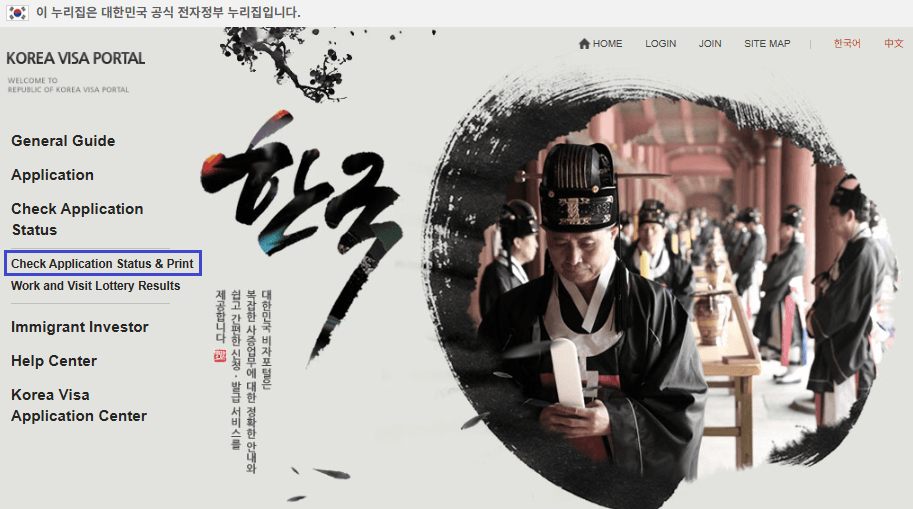
- Visit – www.visa.go.kr – this is the official Korea Visa Portal.
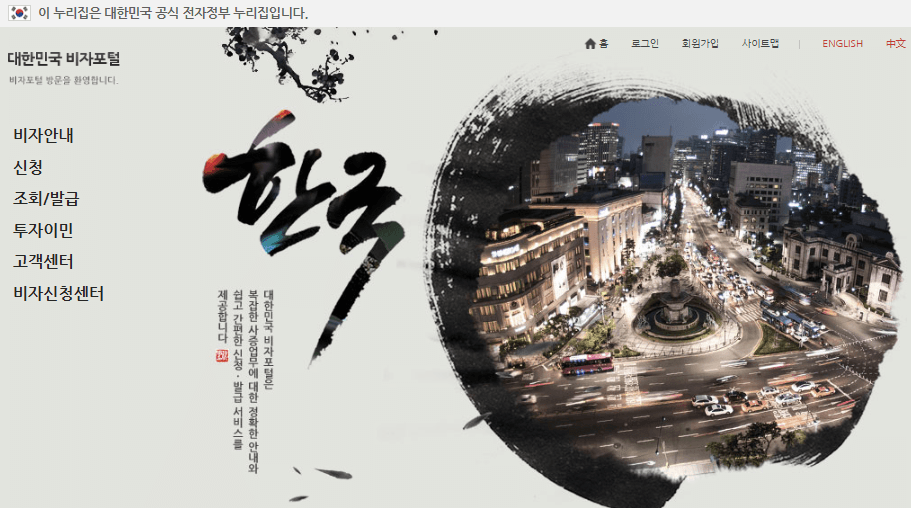
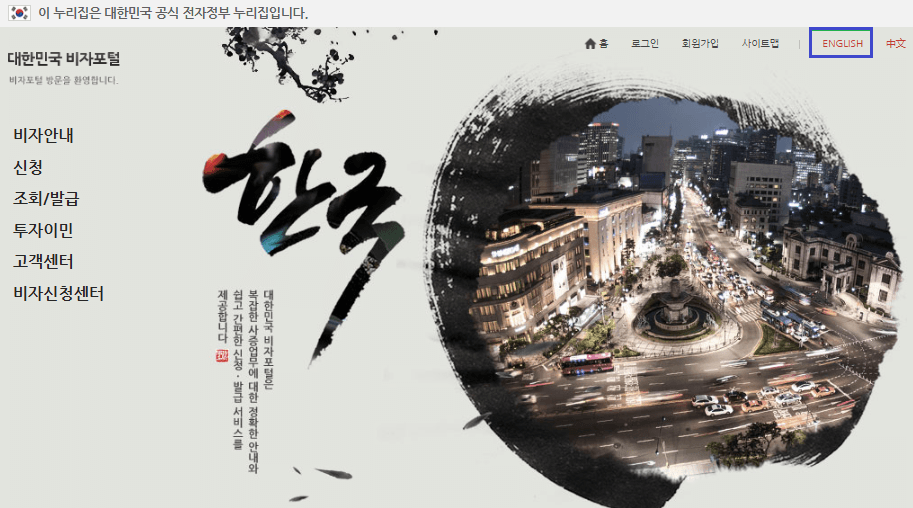
- After opening the Korea visa portal – select the language as English.
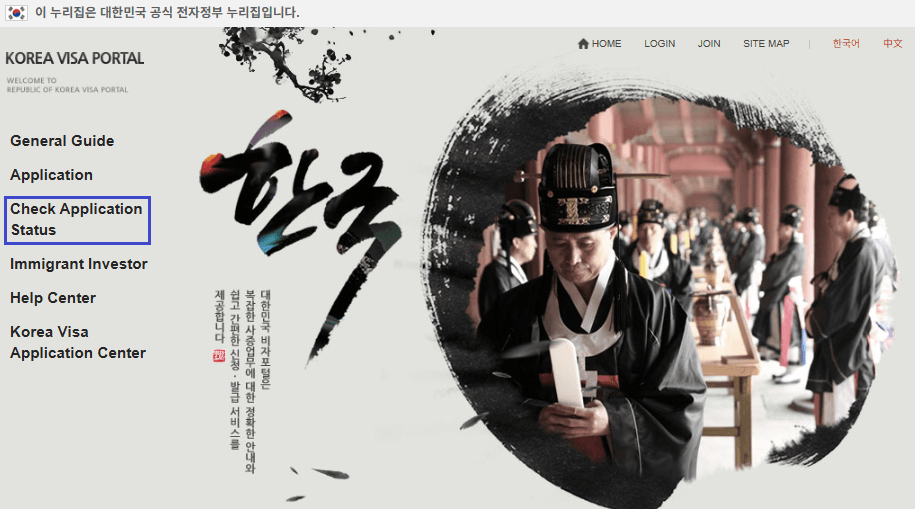
- On the portal homepage, click – Check Application Status – (found on the left side of screen).
- Click Check Application Status And Print.
- Enter your Passport Number, Full Name (Last Name first, then First Name) and Date of Birth.
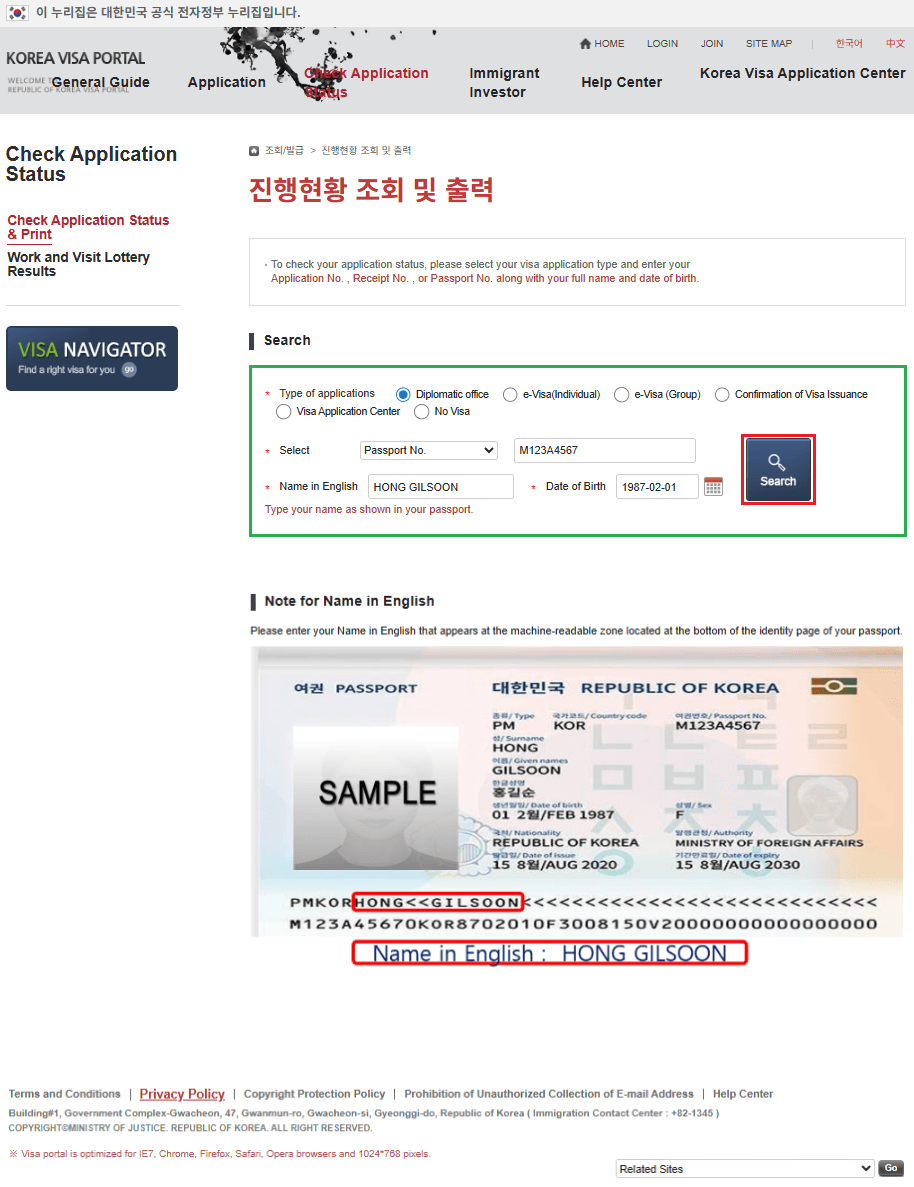
- Click the Search Icon to submit.
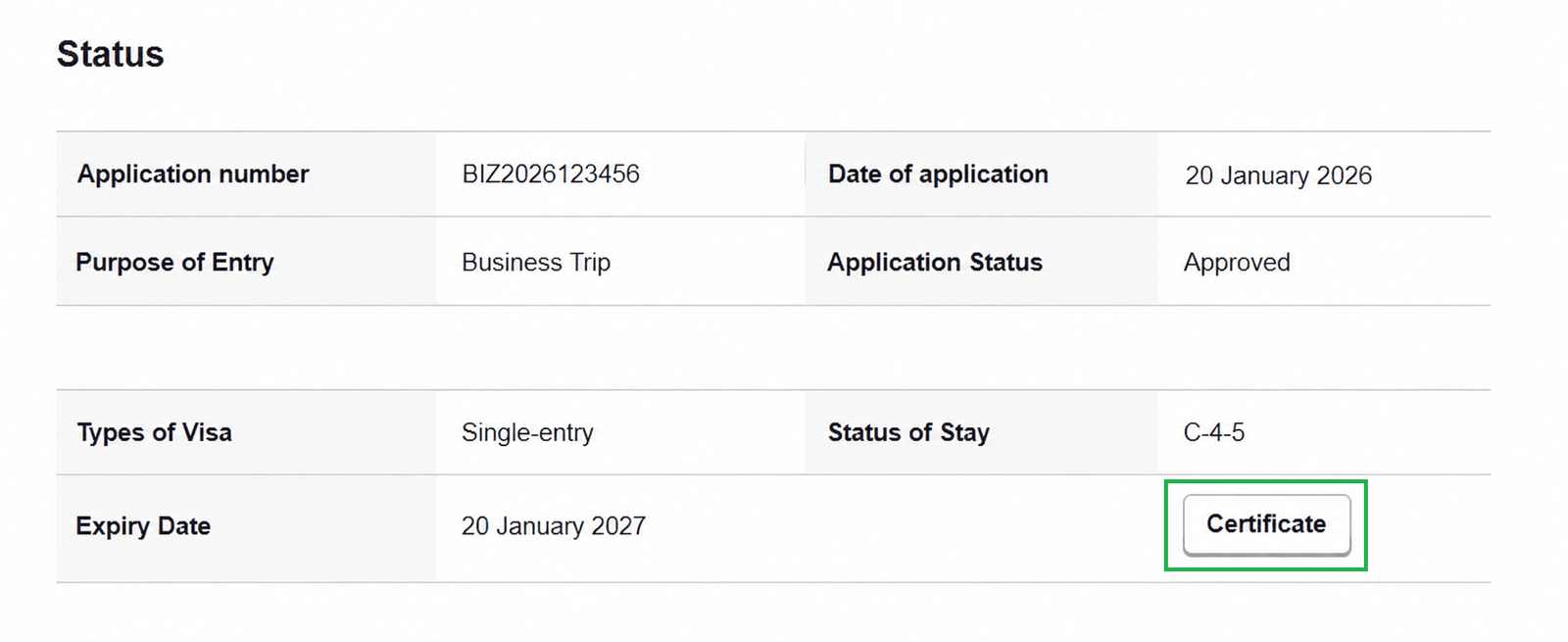
- Your visa status will appear at the bottom of the screen. Once approved, click – Certificate – to download and print your visa
Understanding Your Visa Status
Here is what each status message means and what you should do next.
| Portal Message | What It Means | What To Do |
| No Search Data Found | Your CCVI form was not yet sent by EPS Nepal to the Korean immigration system. Wait and recheck. | Wait 1-2 days and check again. Contact your EPS office or relevant office if it persists. |
| Application Status – Under Review | Your form was sent but the visa has not yet been approved. | Be patient. Processing typically takes 4-7 business days. |
| Application Status – Approved | Your visa has been is approved. | Download the grant certificate from the same portal (Certificates section). |
| Application Status – Rejected | Your visa application was not approved. | Contact the Korean embassy or relevant office for the reason and reapplication guidance. |
For EPS Applicants
- Approved status means your E-9 visa is confirmed.
- Download your visa certificate from the Certificates section on the same portal.
- You must travel to Korea within 3 months of approval.
- Your visa type will also be shown on the approval screen.
- INA-1 – Manufacturing.
- INA-3 – Agriculture.
For e-Visa Applicants
- Your visa is digital – no passport sticker is needed.
- Your Korean university submits documents – Immigration reviews and approves online – You receive the visa by PDF or email.
- Simply show the digital visa at the airport immigration counter.
- No embassy visit is required for visa collection.
9. Total Cost To Go To Korea From Nepal
EPS / E-9 Work Visa – Approximate Cost
| Cost Item | Approximate Cost |
| EPS-TOPIK Exam Fee (Government Rate) | NRs. 1,500 – 2,000 |
| Korean Language Preparation Classes (Optional) | NRs. 30,000 – 60,000 |
| Medical Test (TB Clearance + Fitness) | NRs. 8,000 – 15,000 |
| Police Character Certificate | NRs. 500 – 1,000 |
| Pre-Departure Orientation Training | NRs. 1,500 – 2,000 |
| Insurance and Welfare Fund Deposit | NRs. 10,000 – 15,000 |
| Plane Ticket (One-way: Kathmandu to Seoul) | NRs. 60,000 – 90,000 |
| Total EPS Approximate Cost | NRs. 1.2 – 1.8 Lakh |
D-4 / D-2 Student Visa – Approximate Cost
| Cost Item | Approximate Cost |
| University Application & Admission Processing | NRs. 30,000 – 60,000 |
| TOPIK Exam or IELTS Exam Fee | NRs. 8,000 – 20,000 |
| University First-Year Tuition | NRs. 4 – 12 Lakh (Varies By University & Programme) |
| Visa Application Fee | NRs. 5,400 – 8,100 |
| Fixed Deposit for Bank Balance Proof (Refundable) | USD 10,000 – 20,000 (Stays In Your Account – Not As Expenses) |
| Plane Ticket (One-way: Kathmandu to Seoul) | NRs. 60,000 – 90,000 |
| Initial Settlement (Accommodation, SIM, Transport) | NRs. 50,000 – 80,000 |
| Total First-Year Approximate Cost | NRs. 7 – 18 Lakh (Varies By University & City) |
Part-Time Work Note: Students can work part-time in Korea after 6 months to help offset living costs. Typical monthly earnings – Approx. NRs. 85,000 – 1.25 Lakh (KRW 1,000,000 – 1,500,000).
10. Korea Visa Success Rate From Nepal
Korea visa success rate varies by visa type and applicant profile. Here is what official data and community experience shows for Nepali applicants.
| Visa Type | Success Rate | Key Notes |
| EPS / E-9 | Near 100% (After CCVI) | The real challenge is passing EPS-TOPIK and getting selected by an employer from the roster. |
| D-4 Language Study | High (Top Universities) | Mid-range universities have lower rates – immigration actively tracks student dropout records. |
| D-2 Degree | ~70 – 90% | Requires strong documents, good GPA and sufficient bank balance. |
| E-7 Skilled Worker | Varies | Depends on employer quality, occupation code alignment and document accuracy. More transparent since 2024. |
| C-3 Tourist | Moderate | Strong bank balance, confirmed hotel & flight bookings and a clear itinerary greatly improve approval chances. |
Common Rejection Reasons
- Fake flight tickets or forged documents – 3 to 5 year ban possible.
- Insufficient bank balance.
- GPA below the minimum requirement.
- Gap years not properly explained.
- Name mismatch between documents.
- TB test not done at a designated hospital.
- Applying too close to travel date – Allow at least 3-6 weeks minimum.
Tip: Always submit genuine documents, maintain a strong bank balance and apply well in advance to maximize your visa approval chances.
Important: Any agent claiming to offer a direct Care Giver Visa from Nepal – without the study step – is misleading you.
Disclaimer: The information in this article is for general guidance purposes only. Visa rules, fees and processing times are subject to change without notice. Readers are advised to verify all details directly with the Korean Embassy in Kathmandu or the official visa portal before making any decisions.